Sinus Arrest — ECG Rhythm | Telemetric Pro
A prolonged failure of the SA node to generate impulses, producing extended pauses (>3 seconds) that often require a subsidiary pacemaker escape beat to maintain cardiac output.
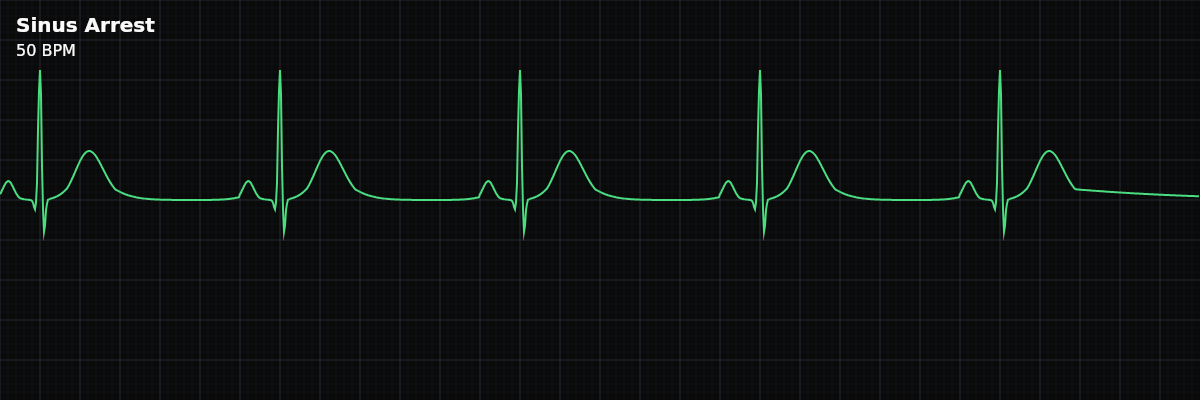
| Rate | Variable (underlying rate with prolonged arrest) |
|---|---|
| Rhythm | Irregular (prolonged period of absent output) |
| P Waves | Upright when present; absent during arrest |
| PR Interval | 0.12–0.20 s (when conducted) |
| QRS Duration | < 0.12 s |
Sinus arrest is the SA node shutting down. Not for a second or two — for three seconds, five seconds, sometimes longer. During that silence, the heart has no pacemaker. No impulse is being generated. No contraction is being commanded. The only thing standing between the patient and asystole is the backup pacemaker system — the junction or the ventricles — which may or may not wake up in time.
For monitor technicians, sinus arrest is a rhythm that requires immediate attention. A 3-second pause means the patient has had no cardiac output for 3 seconds. If the backup pacemakers fail to fire, the pause continues toward asystole. Even when an escape beat does appear, the slow rate (40-60 BPM from the junction, 20-40 BPM from the ventricles) may not provide adequate perfusion.
What Changed from Normal Sinus Rhythm
Sinus arrest is sinus pause taken to the extreme. The same mechanism — SA node failure — produces a longer, more dangerous pause. During the arrest, every waveform disappears: no P waves, no QRS, no T waves. The strip shows a flat isoelectric baseline that can look alarmingly similar to asystole, except that the rhythm was normal moments before and may resume spontaneously or with an escape beat.
Five Criteria: Sinus Arrest vs NSR
- Rate: Bradycardic (effective rate significantly reduced)
- Prolonged pauses drop the effective heart rate well below 60 BPM. If an escape rhythm takes over, the rate is 40-60 (junctional) or 20-40 (ventricular).
- Regularity: Irregular (long pauses interrupt the rhythm)
- The underlying sinus rhythm may be regular, but the arrest creates an extended gap. The irregularity is sudden and dramatic — not gradual like sinus arrhythmia.
- P Waves: Absent during arrest, normal when present
- No P waves appear during the arrest period because the SA node is not firing. Before and after the arrest (if it resolves), P waves are normal and upright.
- PR Interval: Normal when measurable
- In conducted sinus beats, the PR interval is normal. During the arrest, there is no PR to measure. If a junctional escape fires, the PR may be absent or very short.
- QRS Complex: Depends on the source
- Sinus beats have narrow QRS. Junctional escape beats also have narrow QRS (normal conduction). Ventricular escape beats have wide QRS (>0.12s) because they bypass the normal conduction system.
What Sinus Arrest Looks Like on the Strip
On the strip, sinus arrest looks like a normal rhythm that suddenly stops. The baseline goes flat — no P waves, no QRS complexes, nothing — for 3 seconds or more. The pause may end with resumption of normal sinus rhythm (SA node recovers) or with an escape beat from a lower pacemaker (junction or ventricles). If the escape beat has a narrow QRS, it is junctional. If it is wide and bizarre-looking, it is ventricular.
Sinus Arrest vs SA Exit Block
Both produce extended pauses, but the underlying mechanism is different: **Sinus Arrest** — The SA node stops firing entirely. The pause is NOT an exact multiple of the P-P interval because the SA node's internal clock has been reset or stopped. **SA Exit Block** — The SA node continues to fire on schedule, but the impulse cannot exit the node to depolarize the atria. The pause IS an exact multiple of the P-P interval (typically 2x) because the underlying clock is still running.
Clinical Context for Monitor Technicians
Sinus arrest is part of the sick sinus syndrome spectrum — a group of SA node dysfunctions that includes sinus bradycardia, sinus pause, sinus arrest, and tachy-brady syndrome. Common causes include intrinsic SA node disease (age-related fibrosis), medications that suppress the SA node (beta-blockers, calcium channel blockers, digoxin), acute inferior MI (which can compromise SA node blood supply), and severe electrolyte abnormalities.
When to Escalate
**Notify immediately:** - Any pause exceeding 3 seconds — this is sinus arrest by definition - Patient is symptomatic during the pause — dizziness, syncope, altered consciousness - No escape beat appears and the pause continues — the patient is approaching asystole - Ventricular escape beat appears (wide QRS) — indicates the junction also failed to fire, and the ventricles are the last line of defense **Notify promptly:** - Junctional escape beat appears (narrow QRS) — the backup pacemaker is working, but the SA node has failed - Recurrent episodes of sinus arrest — pattern suggests progressive SA node dysfunction