Atrial Flutter (AFL) — ECG Rhythm | Telemetric Pro
A rapid, organized atrial rhythm driven by a single re-entry circuit in the right atrium, producing sawtooth flutter waves at ~300 BPM with variable AV conduction ratios.
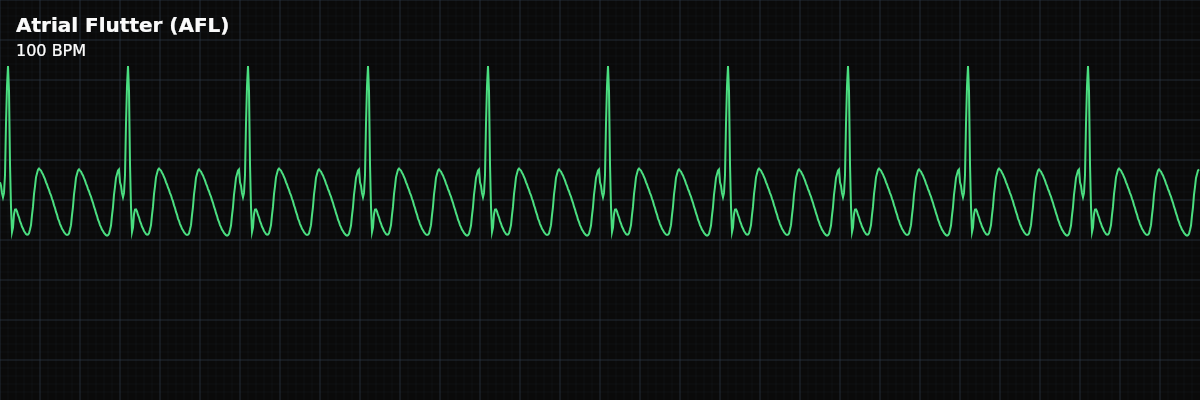
| Rate | Atrial 250–350; ventricular varies by block ratio |
|---|---|
| Rhythm | Regular (if constant block ratio) |
| P Waves | Sawtooth flutter waves |
| PR Interval | Not applicable |
| QRS Duration | < 0.12 s |
Atrial Flutter is the most organized of the atrial tachyarrhythmias. Where atrial fibrillation is electrical chaos — hundreds of random wavelets firing from everywhere — flutter is a single electrical circuit looping around the right atrium at approximately 300 revolutions per minute. The AV node cannot conduct all 300 impulses, so it blocks most of them, letting only every second, third, or fourth one through to the ventricles.
For monitor technicians, flutter is a rhythm you must be able to identify on sight. The sawtooth pattern is one of the most distinctive findings in all of ECG interpretation. The challenge is that at common conduction ratios — especially 2:1 — the flutter waves can be partially hidden within the QRS complexes and T waves, making the rhythm look like sinus tachycardia or SVT at 150 BPM.
What Changed from Normal Sinus Rhythm
Flutter replaces the normal atrial activation entirely. Instead of the SA node firing once per beat and producing a single P wave, the re-entry circuit fires continuously at ~300 BPM. The AV node acts as a gatekeeper, blocking most of these impulses. With 2:1 conduction, every other F wave gets through — producing a ventricular rate of ~150.
Five Criteria: Atrial Flutter vs NSR
- Rate: Atrial ~300, Ventricular depends on block
- The atrial rate is fixed at ~300 BPM (range 250-350). The ventricular rate depends on how many F waves conduct: 2:1 = ~150, 3:1 = ~100, 4:1 = ~75. The conduction ratio is determined by the AV node.
- Regularity: Regular (fixed block) or Irregular (variable block)
- With a fixed conduction ratio (2:1, 3:1, 4:1), the ventricular rhythm is perfectly regular. With variable block (the ratio changes beat to beat), the ventricular rhythm becomes irregular — and can mimic AFib.
- P Waves: Absent — replaced by sawtooth F waves
- There are no P waves. Instead, the baseline shows continuous, identical sawtooth-shaped flutter waves. F waves are best seen in leads II, III, aVF (inverted) and V1 (upright). There is no flat baseline between F waves.
- PR Interval: Not applicable
- There is no discrete P wave, so there is no measurable PR interval. The relationship between F waves and QRS complexes is described by the conduction ratio instead.
- QRS Complex: Narrow (<0.12s)
- Ventricular conduction is normal. The QRS is narrow because the impulse still travels through the AV node and His-Purkinje system in the normal fashion.
What Atrial Flutter Looks Like on the Strip
At 3:1 conduction (Fig 1), the sawtooth pattern is clearly visible — three distinct F waves between each QRS complex. At 2:1 (Fig 2), the pattern is harder to see because only two F waves appear between complexes, and one is often hidden inside the QRS or T wave. This is why 2:1 flutter is the most commonly missed ratio. At 4:1 (Fig 3), the pattern is unmistakable — four F waves clearly visible between each QRS.
Understanding Conduction Ratios
The conduction ratio tells you how many atrial impulses (F waves) occur for every one that conducts to the ventricles: **2:1 conduction** — Two F waves per QRS. Ventricular rate ~150. Most common presentation. F waves are often partially hidden — one may be visible, the other buried in the QRS or T wave. **3:1 conduction** — Three F waves per QRS. Ventricular rate ~100. Less common. More F waves are visible between complexes. **4:1 conduction** — Four F waves per QRS. Ventricular rate ~75. Classic textbook appearance — the sawtooth pattern is clearly visible. **Variable conduction** — The ratio changes from beat to beat (2:1, then 3:1, then 4:1). Produces an irregular ventricular rhythm that can mimic AFib. Look for the regular F-F intervals underneath the irregular QRS spacing.
Atrial Flutter vs Atrial Fibrillation
This is one of the most important distinctions in atrial rhythm interpretation: **Atrial Flutter** — Organized atrial activity from a single circuit. F waves are identical, repeating, and continuous (sawtooth). The atrial rate is ~300 BPM. With fixed conduction, the ventricular rhythm is regular. **Atrial Fibrillation** — Chaotic atrial activity from hundreds of random wavelets. The baseline is wavy and disorganized (fibrillatory). No two waves look the same. The ventricular rhythm is irregularly irregular.
Clinical Context for Monitor Technicians
Atrial flutter commonly occurs in patients with hypertension, coronary artery disease, heart failure, COPD, and post-cardiac surgery. Many patients alternate between flutter and AFib — the two rhythms often coexist. Flutter carries stroke risk similar to AFib, so anticoagulation considerations apply to both.