Isorhythmic AV Dissociation — ECG Rhythm | Telemetric Pro
A benign form of AV dissociation where the sinus node and a junctional pacemaker fire at nearly the same rate. P waves drift slowly relative to QRS complexes, but conduction is intact — this is not a heart block.
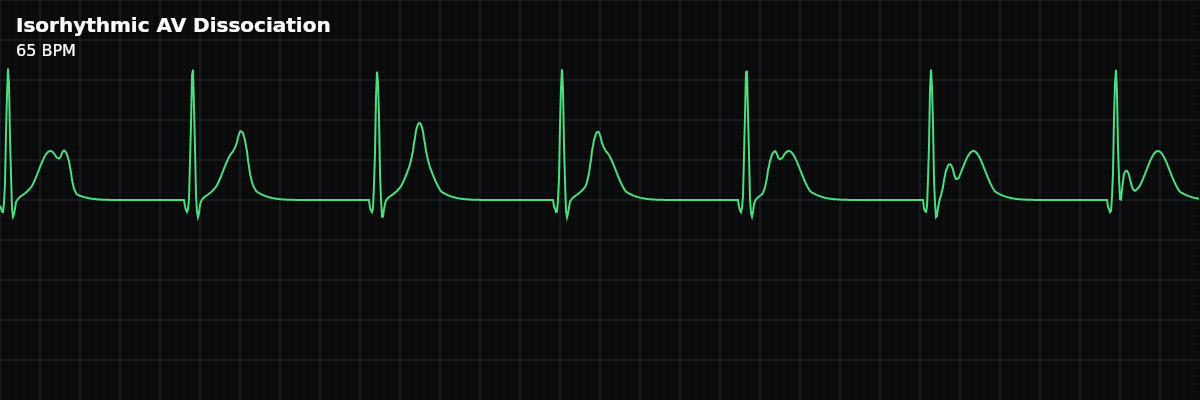
| Rate | 60–80 bpm (atrial ≈ ventricular) |
|---|---|
| Rhythm | Regular (P and QRS each regular, nearly same rate) |
| P Waves | Present, slide relative to QRS |
| PR Interval | Variable (drifts continuously) |
| QRS Duration | Narrow (<0.12s, junctional origin) |
Isorhythmic AV Dissociation is one of the most commonly misidentified rhythms in telemetry. At first glance, it looks like complete heart block — P waves appear to wander independently from the QRS complexes, and the PR interval changes from beat to beat. But the critical difference is the rate: in isorhythmic AVD, the atrial and ventricular rates are nearly identical (within a few beats per minute of each other). In third degree block, the ventricular rate is dramatically slower than the atrial rate because the ventricles depend on a slow escape pacemaker.
What is actually happening is a competition between two pacemakers — the sinus node and the AV junction — that happen to fire at almost the same rate. Because their rates are so close, neither one consistently "captures" the other. The P waves drift slowly toward, into, and then past the QRS complexes in a repeating cycle. The AV node works perfectly fine — the two pacemakers are simply running on similar clocks. This is commonly seen post-anesthesia, in well-conditioned athletes, and during periods of enhanced vagal tone.
Five Criteria: Isorhythmic AVD vs NSR
- Rate: Normal (60-80 bpm)
- Both the atrial rate and ventricular rate are in the normal range. Crucially, they are within a few beats per minute of each other — this is the hallmark that distinguishes isorhythmic AVD from complete heart block, where the ventricular rate is much slower.
- Regularity: Regular (both independently)
- Both P-P intervals and R-R intervals are individually regular. The rates are nearly the same but not locked together, so the P waves appear to slide slowly relative to the QRS complexes.
- P Waves: Present — drift slowly near QRS
- P waves are present and upright but their relationship to the QRS changes gradually. Over several beats, a P wave will drift from before the QRS, into the QRS (hidden), then emerge after the QRS, and eventually cycle back in front. This slow "sliding" is the visual signature.
- PR Interval: Variable (drifts continuously)
- The PR interval changes from beat to beat because the P waves are sliding relative to the QRS. Unlike complete heart block where the PR varies randomly, here it changes gradually and predictably as the two pacemakers drift in and out of phase.
- QRS Complex: Narrow (<0.12s)
- The QRS is narrow because the ventricular pacemaker is junctional — it originates at the AV junction and conducts normally through the bundle branches. A narrow QRS in the setting of AV dissociation is a strong clue that this is isorhythmic AVD, not complete heart block with a ventricular escape.
What Isorhythmic AV Dissociation Looks Like on the Strip
How to Tell It Apart from Complete Heart Block
The single most important differentiator is the ventricular rate relative to the atrial rate: **Complete Heart Block (3rd Degree)** - Ventricular rate is much slower than atrial rate (escape at 20-60 bpm) - Atrial rate is normal (60-100 bpm) but ventricular rate depends on escape focus - QRS may be wide (ventricular escape) or narrow (junctional escape) - Always requires urgent notification **Isorhythmic AV Dissociation** - Ventricular rate is nearly the same as atrial rate (within ~5 bpm) - Both rates are in the normal range (60-80 bpm) - QRS is narrow (junctional origin) - Benign finding — typically self-resolving Use your calipers: if the P-P interval and R-R interval are nearly identical, you are looking at isorhythmic AVD. If the R-R interval is significantly longer (slower rate), consider complete heart block.
When to Escalate
Putting It Together
Isorhythmic AV dissociation means two pacemakers — sinus and junctional — are firing at nearly the same rate. P waves drift slowly relative to the QRS because neither pacemaker dominates. The PR interval varies gradually (not randomly). The ventricular rate is normal (not slow like an escape rhythm). The QRS is narrow. This is a benign finding, not a conduction block. Your job is to recognize the pattern, confirm the rates are nearly equal, and distinguish it from the very different — and dangerous — complete heart block.