Accelerated Junctional Rhythm — ECG Rhythm | Telemetric Pro
A junctional rhythm with enhanced automaticity at 60-100 BPM — faster than the inherent junctional rate but not tachycardic. The junction usurps control from the SA node.
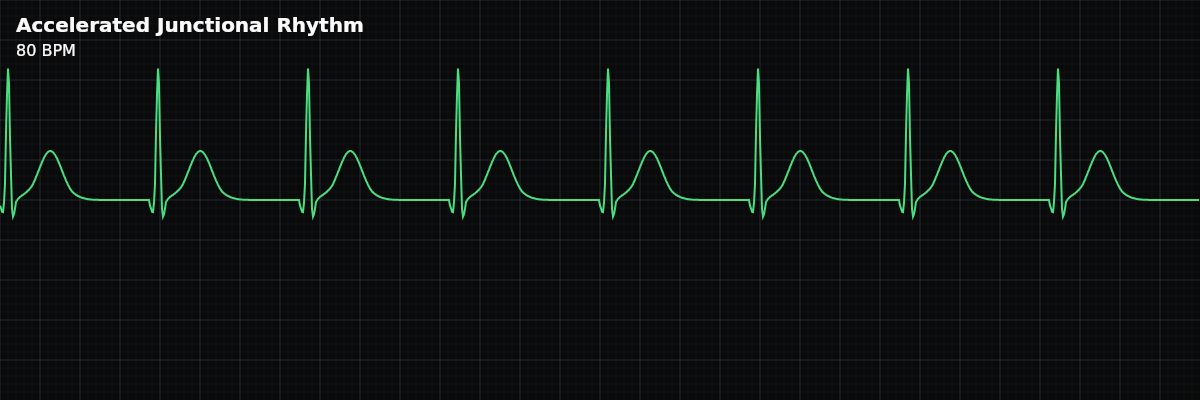
| Rate | 60–100 bpm |
|---|---|
| Rhythm | Regular |
| P Waves | Absent, retrograde, or hidden |
| PR Interval | Short (< 0.12 s) if retrograde P present |
| QRS Duration | < 0.12 s |
Accelerated Junctional Rhythm is the AV junction firing faster than it should. The junction's normal inherent rate is 40-60 BPM — just fast enough to serve as a backup pacemaker. In accelerated junctional rhythm, something has enhanced the junction's automaticity, pushing its rate to 60-100 BPM. At this rate, the junction fires faster than the SA node and takes over as the dominant pacemaker.
For monitor technicians, accelerated junctional rhythm matters because of what it implies. The rhythm itself is usually well-tolerated — the rate is in the normal range. But the cause of the enhanced automaticity may be clinically important: digoxin toxicity, inferior MI, myocarditis, or post-cardiac surgery. When you see this rhythm, the question is always: why is the junction firing faster than it should?
What Changed from Normal Sinus Rhythm
Like all junctional rhythms, accelerated junctional changes the pacemaker source (junction instead of SA node) and the P waves (absent or retrograde instead of upright). The rate happens to fall in the normal range (60-100), which can make it look like NSR at first glance. The key difference: no upright P waves precede the QRS.
Five Criteria: Accelerated Junctional vs NSR
- Rate: 60-100 BPM
- Falls in the normal heart rate range, which is why it is often well-tolerated. The rate is faster than junctional escape (40-60) but slower than junctional tachycardia (>100).
- Regularity: Regular
- The enhanced junctional pacemaker fires at a consistent rate. RR intervals are equal.
- P Waves: Absent or retrograde
- Same as all junctional rhythms: P waves are absent, inverted (retrograde) before the QRS with a short PR, hidden in the QRS, or after the QRS. No upright P waves in lead II.
- PR Interval: Short or not applicable
- If a retrograde P wave precedes the QRS, the PR is very short (<0.12s). Otherwise, no PR interval is measurable.
- QRS Complex: Narrow (<0.12s)
- The impulse travels through the His-Purkinje system normally. QRS morphology is identical to sinus-conducted beats.
What Accelerated Junctional Looks Like on the Strip
On the strip, accelerated junctional looks very similar to NSR — regular, narrow QRS, normal rate range. The giveaway is the absence of upright P waves before each QRS in lead II. Compare the rhythm to the patient's prior sinus strips: if the upright P waves have disappeared but the rate is similar, the junction may have taken over.
Escape vs Accelerated: Why the Distinction Matters
Both junctional escape and accelerated junctional look the same on the strip — the only difference is the rate and the mechanism: **Junctional Escape (40-60 BPM)** — The SA node has failed, and the junction activates as a backup. This is protective. Do not suppress it. **Accelerated Junctional (60-100 BPM)** — The junction is firing faster than normal due to enhanced automaticity, outpacing the SA node. Something is stimulating the junction. Investigate the cause.
Clinical Context for Monitor Technicians
Accelerated junctional rhythm is commonly seen in several specific clinical contexts: digoxin toxicity (classic association — always check if the patient is on digoxin), inferior MI (ischemia of the AV nodal artery), post-cardiac surgery (transient, often resolves within 72 hours), myocarditis or pericarditis, and catecholamine excess (stress, epinephrine).
When to Escalate
**Notify promptly:** - New-onset accelerated junctional rhythm (investigate cause) - Patient on digoxin (possible toxicity) - Patient is symptomatic despite normal-range rate (loss of atrial kick may reduce output) - Rate accelerates beyond 100 BPM (becomes junctional tachycardia — more concerning) **Document and monitor:** - Known accelerated junctional in a stable post-operative patient (expected finding) - Stable, asymptomatic, cause already identified
Putting It Together
Accelerated junctional rhythm is a regular, narrow-complex rhythm at 60-100 BPM with absent or retrograde P waves. The junction is firing faster than its inherent rate due to enhanced automaticity, outpacing the SA node. It is usually well-tolerated but implies an underlying cause — digoxin toxicity, ischemia, surgery, or inflammation. Monitor for progression to junctional tachycardia (>100 BPM).